Safer Weaning and Eating: What the New Choking-Hazard and Food-Texture Expectations Mean in Practice
The research behind texture progression and choking prevention, and exactly what it asks of day nursery staff at mealtimes.
Written byAbraham
Published
Reading time9 min read
Every nursery mealtime carries a small, manageable risk that staff are trained to manage out of existence. EYFS 2026 and Ofsted's Inspection Toolkit now expect that management to be visible and evidenced, not assumed: a setting's Welfare and Wellbeing judgement looks specifically at whether food offered matches each child's developmental stage, whether staff can distinguish a gag from a true choking episode, and whether supervision at the table is active rather than incidental. None of this is new caution dressed up in new language. It reflects a genuine and still-developing research base on how texture, method and supervision interact to create or remove risk.
The theory: why texture and readiness matter
Weaning research has spent two decades testing a basic question: does how food is offered change the risk of choking? The strongest evidence comes from Fangupo et al.'s (2016) randomised controlled trial within the New Zealand BLISS study, which found no difference in choking frequency between infants following a baby-led approach and those following traditional spoon-feeding, provided caregivers received structured guidance on food form and size. Cameron, Heath and Taylor's (2012) review of the baby-led weaning evidence reached a similar conclusion: the approach itself is not inherently riskier, but outcomes depend heavily on which foods are offered and how they are prepared. Morison et al. (2016) and Taylor et al. (2017), both drawing on the BLISS cohort, confirmed that growth and iron status were comparable across feeding styles when guidance was followed, reinforcing that method is not the active ingredient in safety – preparation is. Brown's (2018) survey work reached the same finding outside a trial setting: self-reported choking frequency did not differ meaningfully between baby-led and spoon-fed infants.
Timing and texture progression carry more independent weight than method. Northstone, Emmett and Golding's (2001) analysis of the ALSPAC cohort found that infants not given lumpy foods by 9 months were significantly more likely to be difficult, fussy eaters by 15 months, a finding Coulthard, Harris and Emmett (2009) extended to age 7 – late introduction of texture predicted poorer food acceptance years later. This matters because an overcautious nursery that keeps food smooth for too long out of a wish to avoid any choking risk is trading a managed, lower risk now for a documented higher risk of feeding difficulty later. The ESPGHAN Committee on Nutrition's position paper (Fewtrell et al., 2017) sets the clinical consensus staff should work from: complementary feeding, and textured food specifically, should begin from around six months regardless of feeding approach, with texture progressed according to the individual child's oral-motor stage rather than a fixed calendar age. Carruth and Skinner (2002) and Reilly, Skuse, Mathisen and Wolke's (1995) oral-motor assessment framework both describe what that stage-matching actually requires watching for: tongue lateralisation, chewing pattern, and the ability to move food to the back of the mouth voluntarily, none of which appear on a fixed timetable and all of which staff can observe directly.
Texture should progress with each child's oral-motor stage, not a fixed calendar age. Photo: NHN on Unsplash
The genuine hazard research is narrower and more specific than general caution suggests. Rimell et al.'s (1995) analysis of choking cases remains the foundational source identifying which food properties actually cause airway obstruction: round or cylindrical shape, a size close to a child's airway diameter, and a firm but compressible texture – the profile of a whole grape, a chunk of raw carrot, or a whole nut, rather than food texture in general. Foltran et al. (2012) and Altkorn et al. (2011) confirmed this pattern across larger case series, finding a small, recurring list of high-risk foods rather than a diffuse risk across all solid food. The American Academy of Pediatrics' policy statement (2010) and Pearce, Taylor and Langley-Evans' (2013) review of complementary-feeding timing both support the same practical conclusion: risk is concentrated in specific foods and specific supervision gaps, not in solid food or any single feeding method as such.
What this means at your mealtime table
Treat texture as an individual developmental marker, not a room-wide rule. Two children of the same age may be at different oral-motor stages; plan food form against what you observe each child doing with food, referencing Reilly et al.'s markers – lateral tongue movement, chewing versus sucking, independent mouth clearance – rather than their birth date alone.
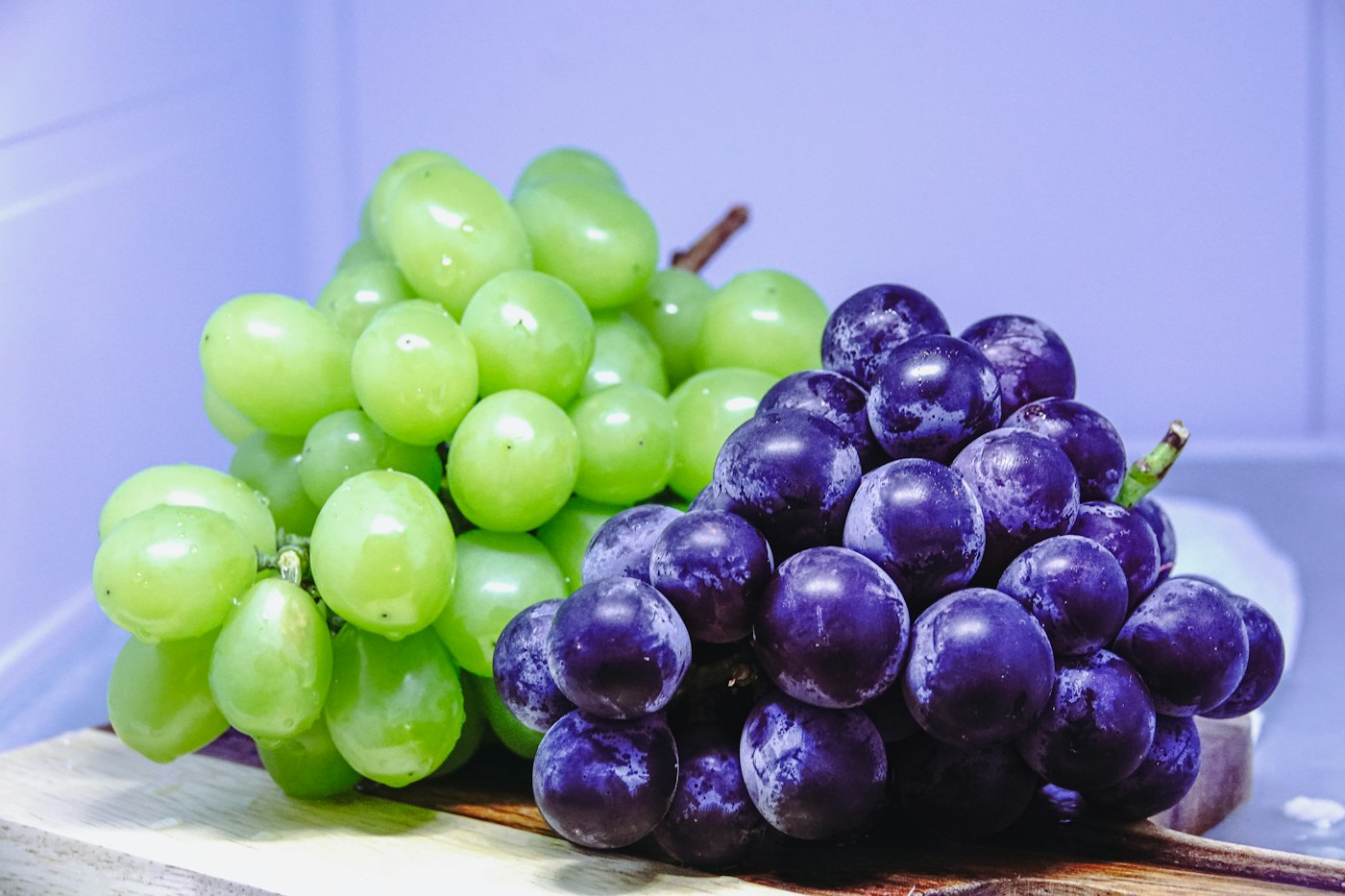
Whole grapes are on the short list of genuinely high-risk foods: halve or quarter them. Photo: Kwon Junho on Unsplash
Name and remove the genuine high-risk foods rather than restricting texture broadly: whole grapes and cherry tomatoes (halve or quarter them), whole nuts, popcorn, hard raw vegetable chunks, hard sweets, and large lumps of meat or cheese. Harris and Coulthard (2016) and the texture-progression evidence above both warn against the opposite error – over-restricting texture generally slows food acceptance without addressing the foods that cause harm.
Train every member of staff to tell gagging from choking, and document that training. A gagging child is noisy, coughing, and often distressed-looking but moving air; a choking child is typically silent. Treating a gag as an emergency or missing a silent choke because it was mistaken for ordinary gagging, are the two most common and most preventable errors, and Ofsted's safeguarding judgement treats staff's ability to tell them apart as a direct test of Welfare and Wellbeing practice.
Active supervision means an engaged adult at the table, watching mouths. Photo: Tanaphong Toochinda on Unsplash
Make supervision active and evidenced: an adult at the table who is engaged – not just present – watching mouths, not scrolling a tablet for observations. Keep your choking-response protocol displayed, rehearsed, and dated, and record food-texture decisions for children with additional needs in their individual care plan, since Fewtrell et al.'s (2017) guidance on stage-matching is only meaningful when it is actually documented against each child's observed stage, not assumed from their age on the register.
References
Altkorn, R., Chen, X., Milkovich, S., Stool, D., Rider, G., Bailey, C. M., Haas, A., Riding, K., & Reilly, J. S. (2011). Nonfatal choking on food among children 14 years or younger in the United States, 2001-2009. International Journal of Pediatric Otorhinolaryngology, 75(12), 1526-1531.
American Academy of Pediatrics, Committee on Injury, Violence, and Poison Prevention. (2010). Policy statement – prevention of choking among children. Pediatrics, 125(3), 601-607.
Brown, A. (2018). No difference in self-reported frequency of choking between infants introduced to solid foods using a baby-led weaning or traditional spoon-feeding approach. Journal of Human Nutrition and Dietetics, 31(4), 496-504.
Brown, A., & Lee, M. (2011). Development and content validation of the Baby Eating Behaviour Questionnaire. Appetite, 56(2), 350-355.
Cameron, S. L., Heath, A.-L. M., & Taylor, R. W. (2012). How feasible is baby-led weaning as an approach to infant feeding? A review of the evidence. Nutrients, 4(11), 1575-1609.
Carruth, B. R., & Skinner, J. D. (2002). Feeding behaviors and other motor development in healthy children (2-24 months). Journal of the American College of Nutrition, 21(2), 88-96.
Coulthard, H., Harris, G., & Emmett, P. (2009). Delayed introduction of lumpy foods to children during the complementary feeding period affects child's food acceptance and feeding at 7 years of age. Maternal & Child Nutrition, 5(1), 75-85.
D'Auria, E., Bergamini, M., Staiano, A., Banderali, G., Pendezza, E., Penagini, F., Zuccotti, G. V., Peroni, D. G., & Italian Society of Pediatrics. (2018). Baby-led weaning: what a systematic review of the literature adds on. Italian Journal of Pediatrics, 44, 49.
Daniels, L., Heath, A.-L. M., Williams, S. M., Cameron, S. L., Fleming, E. A., Taylor, B. J., Wheeler, B. J., Gibson, R. S., & Taylor, R. W. (2015). Baby-Led Introduction to SolidS (BLISS) study: a randomised controlled trial of a baby-led approach to complementary feeding. BMC Pediatrics, 15, 179.
Fangupo, L. J., Heath, A. M., Williams, S. M., Erickson Williams, L. W., Morison, B. J., Fleming, E. A., Taylor, B. J., Wheeler, B. J., & Taylor, R. W. (2016). A baby-led approach to eating solids and risk of choking. Pediatrics, 138(4), e20160772.
Fewtrell, M., Bronsky, J., Campoy, C., Domellöf, M., Embleton, N., Fidler Mis, N., Hojsak, I., Hulst, J. M., Indrio, F., Lapillonne, A., & Molgaard, C. (2017). Complementary feeding: A position paper by the European Society for Paediatric Gastroenterology, Hepatology, and Nutrition (ESPGHAN) Committee on Nutrition. Journal of Pediatric Gastroenterology and Nutrition, 64(1), 119-132.
Foltran, F., Ballali, S., Rodriguez, H., Sae Hong, S., Gregori, D., & Passali, D. (2012). Food choking hazards in children. International Journal of Pediatric Otorhinolaryngology, 76(Suppl 1), S12-S15.
Harris, G., & Coulthard, H. (2016). Early eating behaviours and food acceptance revisited: breastfeeding and introduction of complementary foods as predictive of food acceptance. Current Obesity Reports, 5(1), 113-120.
Morison, B. J., Taylor, R. W., Haszard, J. J., Schramm, C. J., Williams Erickson, L., Fangupo, L. J., Fleming, E. A., Luciano, A., & Heath, A.-L. M. (2016). How different are baby-led and conventional complementary feeding? A cross-sectional study of infants aged 6-8 months. BMJ Open, 6(5), e010665.
Northstone, K., Emmett, P., & Golding, J. (2001). The effect of age of introduction to lumpy solids on foods eaten and reported feeding difficulties at 6 and 15 months. Journal of Human Nutrition and Dietetics, 14(1), 43-54.
Pearce, J., Taylor, M. A., & Langley-Evans, S. C. (2013). Timing of the introduction of complementary feeding and risk of childhood obesity: a systematic review. International Journal of Obesity, 37(10), 1295-1306.
Rapley, G. (2011). Baby-led weaning: transitioning to solid foods at the baby's own pace. Community Practitioner, 84(6), 20-23.
Reilly, S., Skuse, D., Mathisen, B., & Wolke, D. (1995). The objective rating of oral-motor functions during feeding. Dysphagia, 10(3), 177-191.
Rimell, F. L., Thome, A., Stool, S., Reilly, J. S., Rider, G., Stool, D., & Wilson, C. L. (1995). Characteristics of objects that cause choking in children. JAMA, 274(22), 1763-1766.
Taylor, R. W., Williams, S. M., Fangupo, L. J., Wheeler, B. J., Taylor, B. J., Daniels, L., Fleming, E. A., McArthur, J., Morison, B., Erickson, L. W., & Heath, A.-L. M. (2017). Effect of a baby-led approach to complementary feeding on infant growth and overweight: A randomized clinical trial. JAMA Pediatrics, 171(9), 838-846.
Operations Director, Awake Early Years Consultancy
Former Ofsted Early Years Inspector, doctoral researcher and early childhood education and care consultant with over 16 years' experience across practice, inspection and leadership.