Meeting the EYFS Screen-Use Requirement: A CPD Article for Day Nursery Practitioners
Since 1 September 2026 the EYFS requires nurseries to have regard to the DfE's screen-use guidance. What it asks, what the research can and cannot tell us, and how to turn both into daily practice you can show to parents and inspectors.
Written byAbraham
Published
Reading time25 min read
Purpose and what has changed
Since 1 September 2026, the EYFS statutory framework requires nurseries to have regard to the Department for Education's (DfE) screen-use guidance. Ofsted inspects against the EYFS, so this article treats the requirement as one you will be asked to explain and evidence, not as a separate Ofsted rule.
This article is written for practitioners, room leaders and managers in day nurseries. It sets out what the guidance asks, what the research can and cannot tell us, and how to turn both into daily practice you can show to parents and inspectors. It also works as a team CPD session (see the activity plan near the end).
What the DfE guidance says, in brief
Children under 2: avoid screen time altogether, other than in exceptional circumstances such as a video call with a parent or carer.
Children aged 2 to 5: no more than one hour a day, and less if possible.
These limits do not apply to screen-based assistive technology for children with SEND.
Screen use should be limited, planned and linked to clear learning aims, and adults should always co-engage.
Three points that trade-press summaries often get wrong
The guidance is a statutory regard duty, not a ban. The DfE says screens can be used "carefully and intentionally, for specific learning and development aims" and does not ask settings to remove them.
A standalone policy is encouraged, not stated as compulsory. The DfE says you "may want to establish a policy" and share it with parents. Some commercial sites describe a September deadline for a written policy; the official guidance does not say that.
I could not find screen use mentioned in Ofsted's operating guide for inspectors (for use from September 2026), apart from separate points on phones and AI. Expect inspectors to meet this through the usual routes: the quality of interactions, the curriculum, safeguarding and leadership.
The DfE guidance was published on 13 July 2026 and updated on 7 September 2026. Check it again before you finalise your own policy, as it may be revised.
What the DfE guidance asks of your setting
The guidance separates screen time (how long a child looks at a screen) from screen use (how, why and in what context, including the pace and quality of content and the child's level of engagement). Inspectors and parents will care about both, so your practice needs a rationale as well as a clock.
It applies to every device with a screen: tablets, laptops, phones, televisions, interactive whiteboards, touch tables, e-readers, smart watches, video platforms, and gaming devices or toys with screens.
Time What the guidance says: Under 2s: avoid, except in exceptional circumstances. Ages 2 to 5: up to 1 hour a day, less if possible. Children may already reach this at home. What it can look like in a nursery: Log any screen use by room. Treat the hour as a ceiling that is rarely approached, not a target.
Purpose What the guidance says: Limited, carefully planned and linked to learning aims. Ask whether it is necessary and whether another resource would do. What it can look like in a nursery: A short planning note: what is the aim, why a screen, what would we use otherwise?
Adult role What the guidance says: Never let children use screens alone or without adult co-engagement. Comment, narrate, describe, ask open questions. Avoid passive viewing. What it can look like in a nursery: Adult sits with the child, pauses the content and talks about it. No "set it going and walk away".
Content What the guidance says: Checked beforehand; slow-paced, repetitive and predictable; advert-free; no scrolling or autoplay, including algorithm-driven video platforms. What it can look like in a nursery: Pre-select and pre-watch. Use a downloaded clip or offline resource, not a live video platform feed.
AI What the guidance says: Avoid children using AI until better evidence exists, including toys with built-in AI. What it can look like in a nursery: Check toys and apps for AI features before they enter a room.
Daily rhythm What the guidance says: Not at mealtimes or within an hour of sleep. No background screens. Not to calm, occupy, manage behaviour or fill transitions. Consider permanently screen-free spaces. What it can look like in a nursery: Screens off in baby, toddler and sleep rooms. Plan transitions with songs, rhymes and routines instead.
Staff devices What the guidance says: Digital assessment should be proportionate and short. Pre-reception assessment should rest on observation and judgement, not on children doing screen tasks. Keep images and videos of children to a minimum and share them securely. What it can look like in a nursery: Review how often staff are heads-down on tablets in the room. Tie this to your safeguarding policy on phones and cameras.
The DfE also asks settings to teach children, in age-appropriate ways, about the technology around them, and to discourage children from bringing their own devices into the setting.
What the research tells us, and what it cannot
The research supports caution with very young children, but most of it shows association, not proof of harm. The DfE's own Early Years Screen Time Advisory Group acknowledged that evidence on the harms and benefits of screens for under-5s is limited and often low quality (as summarised by Slough Borough Council). Most studies below are parent-reported home studies rather than nursery studies, and many come from outside the UK. Read every finding as "is associated with", never "causes".
Language, development and attention
In a Canadian cohort of 2,441 mother-child pairs, more screen time at 24 and 36 months was followed by lower scores on a developmental screening test at 36 and 60 months, though the effects were small (Madigan et al., 2019).
A meta-analysis of 42 studies (18,905 children) linked screen time and background television to weaker language skills. It also linked educational content, co-viewing and later onset of screen use to stronger language, again with small effects (Madigan et al., 2020).
In a Japanese cohort of 7,097 pairs, more screen time at age 1 was associated, in a dose-response pattern, with communication and problem-solving delay at ages 2 and 4. The measure was a screening tool, not a diagnosis, and educational and non-educational content were not separated (Takahashi et al., 2023).
In a US cross-sectional survey, each extra daily hour of baby DVD or video viewing was linked to lower vocabulary scores in infants aged 8 to 16 months, but not in older toddlers (Zimmerman, Christakis and Meltzoff, 2007).
Earlier US data linked each extra daily hour of television at ages 1 and 3 to slightly higher odds of attention problems at age 7 (Christakis et al., 2004). In a Canadian birth cohort, children with more than two hours a day at age 5 showed more inattention than those with under 30 minutes, with wide confidence intervals (Tamana et al., 2019).
A small MRI study of 47 children aged 3 to 5 found that screen use above American Academy of Pediatrics guidance was associated with lower white matter integrity in language and literacy tracts. It was cross-sectional, so it cannot show cause (Hutton et al., 2020).
A longitudinal eye-tracking study of 40 children found that high touchscreen users showed faster attention orienting but weaker voluntary attention control. It is correlational and small (Portugal et al., 2021).
Not every finding is negative. A UK parent survey linked earlier touchscreen scrolling to earlier block stacking, a fine motor milestone, with no link to walking or first two-word speech (Bedford et al., 2016).
A systematic review of 96 studies on sedentary behaviour in the early years found screen time mostly unfavourable or null for adiposity, motor, cognitive and psychosocial outcomes, whereas reading and storytelling were favourable or null for cognitive development. The authors rated the evidence quality as very low to moderate (Poitras et al., 2017).
Sleep and self-regulation
In a UK survey of 715 families with children aged 6 to 36 months, more daily touchscreen use was associated with less night-time sleep, more daytime sleep and a longer time to fall asleep, though not with more night waking. Sleep was parent-reported (Cheung et al., 2017). This fits the DfE's advice to avoid screens within an hour of sleep.
A small US study of 144 parent-child pairs found that toddlers with social-emotional difficulties were more likely to be given devices to calm them. It cannot tell us which came first (Radesky et al., 2016). It is a reason to be wary of using screens to settle children, not proof that doing so causes difficulties.
More daily touchscreen use has been linked with less night-time sleep and a longer time to fall asleep, which is why the DfE advises no screens within an hour of sleep. Photo: Helena Lopes on Unsplash
Talk and interaction
With a television on in the background, parents of 1 to 3-year-olds talked to their children about 20% less and were less active, attentive and responsive (Kirkorian et al., 2009). Children's play was also shorter and their focused attention briefer, though the effect was small (Schmidt et al., 2008).
In a small home experiment (26 parent-infant pairs), electronic toys led to fewer adult words, fewer conversational turns and fewer parental responses than traditional toys or books. These were electronic toys, not screens as such (Sosa, 2016).
An earlier review concluded that very young children learn much less from video than from the same material presented live, and that background television disrupts their activity (Anderson and Pempek, 2005).
Learning from screens: what makes the difference
The best-supported message is that the adult and the content matter more than the device.
Infants and toddlers transfer less of what they see on a screen to real life, the "transfer deficit". Repetition and cues reduce the gap (Barr, 2013). Toddlers transferred a word from video to real objects reliably only when a parent pointed out that the objects were the same (Strouse and Troseth, 2014).
In a randomised study of 81 parent-child pairs, 3-year-olds whose parents asked dialogic questions while watching together showed better story comprehension and vocabulary than children in other conditions (Strouse, O'Doherty and Troseth, 2013).
A learning-science review proposed four tests for any app: is the learning active, engaged, meaningful and socially interactive? It noted that few apps have been independently tested (Hirsh-Pasek et al., 2015). The "educational" label is not enough, which echoes the DfE's warning to judge apps by your own professional judgement.
A review of tablets and early literacy suggests possible benefits for early writing and letter knowledge, but the overall effect is unclear and depends on app quality and adult scaffolding (Neumann and Neumann, 2017). Kirkorian, Wartella and Anderson (2008) review how early media exposure may affect learning and set out ways to maximise the benefits.
How common is exceeding the limits?
A meta-analysis of 63 studies (89,163 children aged 5 and under, data collected before the pandemic) found that about one in four under-2s met a "no screens" benchmark and about 36% of 2 to 5-year-olds met a one-hour benchmark (McArthur et al., 2022). Many of the children in your care may already be at or beyond the limit before they arrive, which is why the DfE asks settings to bear this in mind when planning their own use.
Turning the guidance into daily practice
Most screen use in a nursery is not planned. It creeps in at the edges of the day: a clip while children wait for lunch, a tablet to settle someone at the door, a TV on in the background. The most effective first step is to find those moments and decide what replaces them.
Start with the baby and toddler rooms
The rule for under-2s is the simplest: no screen time, other than exceptional circumstances such as a video call with a parent or carer. Agree as a team what counts as "exceptional", write it down, and note each time it happens. Staff phones and tablets used for observations are also worth reviewing, because the DfE asks that digital assessment is short and does not take adults away from the children for long stretches.
Replace the habit, not just the screen
Arrival and settling The habit to watch for: A device to distract a child who is upset. What to try instead: A comfort object, a familiar song, a key person cuddle and a favourite book. The DfE says screens should not be used to calm children.
Waiting and transitions The habit to watch for: A clip while tables are set or children queue. What to try instead: Rhymes, movement games and a visual routine. The DfE says screens should not fill transitions.
Mealtimes The habit to watch for: Background TV or video. What to try instead: Screens off; use the time for conversation and modelling.
Before sleep The habit to watch for: A calming video. What to try instead: A story told by an adult. The DfE advises avoiding screens within an hour of sleep.
Rainy days The habit to watch for: A film to fill a long indoor session. What to try instead: A planned indoor active-play menu. Screens should not replace physical activity.
Group time The habit to watch for: A song or story played from a screen. What to try instead: Sing and tell it live. The DfE notes a screen cannot match an adult who makes eye contact, changes voice and responds to children.
Staff admin The habit to watch for: Tablets in the room during busy periods. What to try instead: Time-boxed observation windows, then devices away.
Sing and tell it live: a screen cannot match an adult who makes eye contact, changes voice and responds to children. Photo: Amonwat Dumkrut on Unsplash
If you do use a screen: a simple routine
The DfE asks for screen use that is purposeful and adult-supported. One workable pattern is before, during, after.
Before. Write one line: what is the learning aim, and why is a screen better than a real object or live activity? Watch the content first. Check it is slow, repetitive, advert-free and has no autoplay or scrolling.
During. Sit with the children, and keep it short. Comment, narrate and ask open questions, and pause the content to let them predict or respond. Dialogic questioning during shared viewing has been linked to better comprehension and vocabulary (Strouse, O'Doherty and Troseth, 2013).
After. Take the idea off the screen straight away. Point to the real object, sing the song, build the thing. Toddlers are more likely to transfer what they see on screen to real life when an adult makes the link explicit (Strouse and Troseth, 2014; Barr, 2013).
A simple screen-use log
Keeping a log shows you are managing time, and also shows you purpose. A short entry per use is enough. Each entry records:
Date
Room and age group
Device and content
Minutes
Learning aim
Adult co-engaging
Follow-up activity
Children who are already over the limit at home
The DfE reminds settings that many children may already reach the daily limit at home. That is a reason for nursery to be a low-screen environment, and for staff to talk about it without judgement (see the section on parents).
Working with parents and carers
The DfE asks settings to work in partnership with families, explain how and why screens are used, and keep every conversation non-judgemental and empathetic. Parents may well look to you for advice, and the DfE points families to its baby and toddler screen time guidance on Best Start in Life.
Ways the DfE suggests sharing your approach
Share your screen-use policy or approach when a child joins.
Mention it in conversations and at handovers.
Include key messages in newsletters.
What to share with families
The recommended daily limits (none under 2, up to one hour for ages 2 to 5).
How screen use can displace sleep, play, talk and physical activity.
Practical alternatives to reduce screen use at home.
Language that helps
Say "here is what we do in nursery and why", not "you should".
Acknowledge that screens are often a coping tool when parents are tired or working from home.
Offer one small idea at a time, such as a screen-free mealtime or a bedtime story an hour before sleep.
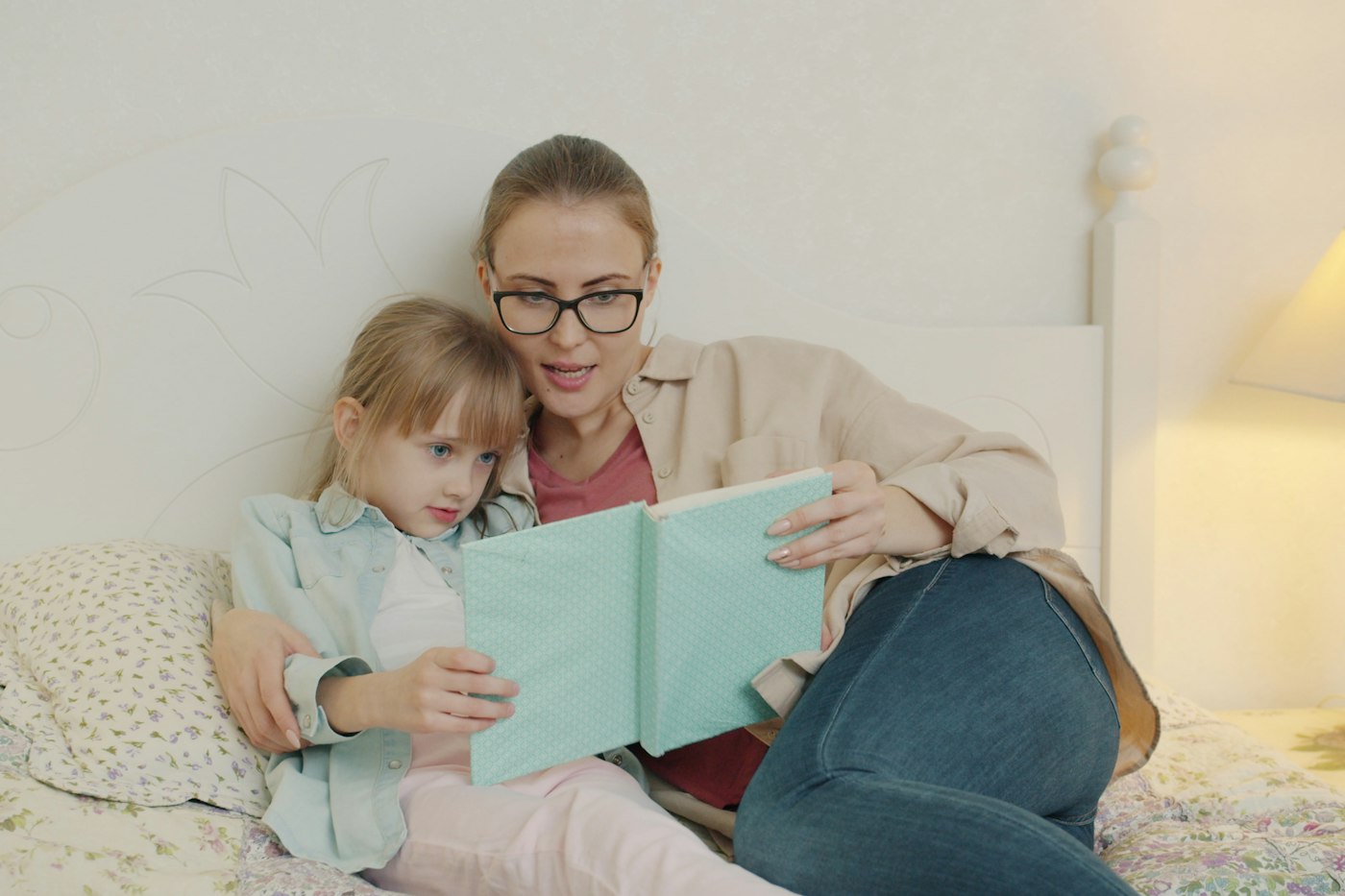
Offer families one small idea at a time, such as a bedtime story an hour before sleep. Photo: Vitaly Gariev on Unsplash
Staff need to feel confident for this to work. The DfE says your team must understand your policy and feel supported to offer practical advice. A short staff briefing with a few agreed phrases is more effective than a leaflet alone. Involving parents in your policy review, for example by asking what they would like to know, also helps your inspection evidence show partnership in practice.
SEND, communication needs and assistive technology
The DfE's time limits do not apply to screen-based assistive technology for children with SEND. For some children these tools have "essential benefits for communication, well-being and quality of life". The guidance also says some children with SEND or English as an additional language may need a more tailored approach, including children with communication difficulties that are not formally diagnosed, and asks practitioners to judge case by case whether assistive technology will support a child's learning.
Two systematic reviews give a sense of the evidence, though neither is specific to nurseries:
A review of 29 studies of augmentative and alternative communication (AAC) for children aged 0 to 6 with a range of diagnoses reported improvements in expressive and receptive communication, functional communication and symbol use across a variety of AAC systems. It covers AAC generally, not only screen-based tools (Leonet et al., 2022).
A review of 24 studies involving 60 autistic children aged 2 to 5 reported largely positive results for mobile devices as aids across communication, academic and social skills. It covers autism only, and the sample is small (Al-Rashaida et al., 2022).
Practical points for your setting
Separate a child's communication device from entertainment use. The first is exempt from the daily limit; the second is not.
Record the purpose in the child's support plan, and agree it with the SENCo and parents.
Keep adult interaction central. A device supports communication when adults model, wait and respond, and it is not a replacement for that.
The same checks on content, safety and AI features still apply to any app used with the device, and the DfE's "avoid AI" advice applies to the child's use of AI features generally.
Writing your policy and evidencing practice
A written policy is the clearest way to show you have had regard to the guidance, and the DfE suggests one. It should say what you decided and why, and it only helps if staff can describe it without reading it.
What a short, usable policy covers
Purpose and scope. Why you limit screens, and which devices count (use the DfE's list, including interactive whiteboards and toys with screens).
Limits by age. None under 2 except exceptional circumstances (name them, for example a video call with a parent), and up to one hour a day for ages 2 to 5, with less as the aim.
Permitted purposes. The learning aims for which a screen may be used, and the uses you have ruled out (calming, occupying, managing behaviour, filling transitions, background viewing).
Adult role. Co-engagement is always required, and passive viewing is not allowed.
Content checks. Who checks content, how, and the standards: slow-paced, repetitive, advert-free, no autoplay or scrolling.
AI. Children do not use AI or AI-enabled toys.
Daily rhythm. No screens at meals or within an hour of sleep, and which rooms or spaces are screen-free.
SEND and assistive technology. How decisions are made and recorded, and how these devices are separated from other use.
Staff devices, images and assessment. Link to your safeguarding policy. The EYFS requires that policy to cover how mobile phones, cameras and other devices with imaging and sharing capabilities are used.
Parents. How you will share the policy and offer advice.
Monitoring and review. Who reviews the log, how often, and when the policy is next reviewed against the DfE guidance.
Evidence worth keeping
The policy, with a review date and a note of the DfE guidance version you used.
Your screen-use log and the planning note for any planned use.
Staff briefing or CPD records, including this activity.
Examples of parent communication.
Room observations showing adults talking, questioning and linking screen content to real experiences.
Be ready to explain it in your own words
These prompts are my suggestions for team practice. They are not an official Ofsted list.
"How do you use screens with the children, and why?" What a strong answer sounds like: Names the specific learning aim, says what else you considered, and describes the adult's role.
"What do you do with the youngest children?" What a strong answer sounds like: No routine screen use; names the exceptional cases and how they are recorded.
"How do you stop screens being used to calm or occupy children?" What a strong answer sounds like: Gives concrete alternatives, such as songs, books and key-person comfort.
"How do you decide whether an app is good?" What a strong answer sounds like: Checks content in advance and against the DfE criteria, not by the "educational" label.
"How do you work with parents on this?" What a strong answer sounds like: Explains how and when the approach is shared, and the tone used.
"What have you changed because of the guidance?" What a strong answer sounds like: Names a real change, for example removing background TV or reviewing staff tablet use.
A note on AI: Ofsted's operating guide says inspectors do not directly evaluate the use of AI by settings, but would look at the quality of leaders' decision-making if they find it. That is separate from the DfE's advice that children avoid AI, which belongs in your screen-use policy.
Reflection and a team CPD activity plan
Sheridan et al. (2009) argue that the early years field needs better evidence on how professional development produces lasting change in practitioners, so this plan builds in a follow-up to check what has actually changed. Research with practitioners also suggests that their views of play-based pedagogy influence whether they use digital devices (Palaiologou, 2016), and an early observational study found adult support at computers was mostly reactive rather than guided (Plowman and Stephen, 2005). Plowman et al. (2012) describe the technology children meet at home and the learning it can support, which is useful background for conversations with families. That is why this plan starts with your own habits.
Individual reflection (the DfE's own questions)
Is the screen use necessary? Are there other methods or resources I could use instead?
What is the clear educational rationale for using a screen?
How does it extend and enhance learning, rather than replace my role?
How can I make sure children are interacting, not passively watching? How will I discuss the content with them?
Is the content designed for educational purposes and appropriate for early years children?
How can I introduce movement and physical activity?
Are there safeguarding risks around the device or content, and has it been effectively checked?
Team session plan (about 90 minutes, plus a follow-up)
10 minutes. Read the DfE guidance page together. Note the three rules for under-2s and 2 to 5s. Output: shared understanding.
15 minutes. Audit: list every screen in every room (TVs, tablets, whiteboards, toys, staff devices) and when each is used. Output: a screen map.
20 minutes. Sort each use: purposeful and adult-led, habit, or background. Mark habits to replace. Output: a keep / change / stop list.
15 minutes. Choose replacements for the top three habits, using the practice ideas above. Output: a room action plan.
15 minutes. Role-play a parent conversation using non-judgemental language. Output: agreed phrases.
15 minutes. Draft or revise the policy headings. Assign an owner and a review date. Output: a policy draft.
Follow-up, 4 to 6 weeks later. Review the log and a short observation of one room. Ask: what has changed? Output: evidence and next steps.
CPD record
Each practitioner completes:
Date and duration
What I learned
One thing I will change in my room
How I will check it worked
Date of follow-up
References
Peer-reviewed sources
Al-Rashaida, M., Amayra, I., López-Paz, J.F. et al. (2022) Studying the effects of mobile devices on young children with autism spectrum disorder: a systematic literature review. Review Journal of Autism and Developmental Disorders, 9(3), pp. 400-415. doi:10.1007/s40489-021-00264-9
Anderson, D.R. and Pempek, T.A. (2005) Television and very young children. American Behavioral Scientist, 48(5), pp. 505-522. doi:10.1177/0002764204271506
Barr, R. (2013) Memory constraints on infant learning from picture books, television, and touchscreens. Child Development Perspectives, 7(4), pp. 205-210.
Bedford, R., Saez de Urabain, I.R., Cheung, C.H.M., Karmiloff-Smith, A. and Smith, T.J. (2016) Toddlers' fine motor milestone achievement is associated with early touchscreen scrolling. Frontiers in Psychology, 7, article 1108. doi:10.3389/fpsyg.2016.01108
Cheung, C.H.M., Bedford, R., Saez De Urabain, I.R., Karmiloff-Smith, A. and Smith, T.J. (2017) Daily touchscreen use in infants and toddlers is associated with reduced sleep and delayed sleep onset. Scientific Reports, 7, article 46104. doi:10.1038/srep46104
Christakis, D.A., Zimmerman, F.J., DiGiuseppe, D.L. and McCarty, C.A. (2004) Early television exposure and subsequent attentional problems in children. Pediatrics, 113(4), pp. 708-713. doi:10.1542/peds.113.4.708
Hirsh-Pasek, K., Zosh, J.M., Golinkoff, R.M., Gray, J.H., Robb, M.B. and Kaufman, J. (2015) Putting education in "educational" apps: lessons from the science of learning. Psychological Science in the Public Interest, 16(1), pp. 3-34. doi:10.1177/1529100615569721
Hutton, J.S., Dudley, J., Horowitz-Kraus, T., DeWitt, T. and Holland, S.K. (2020) Associations between screen-based media use and brain white matter integrity in preschool-aged children. JAMA Pediatrics, 174(1), e193869. doi:10.1001/jamapediatrics.2019.3869
Kirkorian, H.L., Wartella, E.A. and Anderson, D.R. (2008) Media and young children's learning. The Future of Children, 18(1), pp. 39-61. doi:10.1353/foc.0.0002
Kirkorian, H.L. et al. (2009) The impact of background television on parent-child interaction. Child Development, 80(5), pp. 1350-1359.
Leonet, O., Orcasitas-Vicandi, M., Langarika-Rocafort, A., Idoiaga Mondragon, N. and Roman Etxebarrieta, G. (2022) A systematic review of augmentative and alternative communication interventions for children aged from 0 to 6 years. Language, Speech, and Hearing Services in Schools, 53(3), pp. 894-920. doi:10.1044/2022_LSHSS-21-00191
Madigan, S., Browne, D., Racine, N., Mori, C. and Tough, S. (2019) Association between screen time and children's performance on a developmental screening test. JAMA Pediatrics, 173(3), pp. 244-250. doi:10.1001/jamapediatrics.2018.5056
Madigan, S., McArthur, B.A., Anhorn, C., Eirich, R. and Christakis, D.A. (2020) Associations between screen use and child language skills: a systematic review and meta-analysis. JAMA Pediatrics, 174(7), pp. 665-675. doi:10.1001/jamapediatrics.2020.0327
McArthur, B.A., Volkova, V., Tomopoulos, S. and Madigan, S. (2022) Global prevalence of meeting screen time guidelines among children 5 years and younger: a systematic review and meta-analysis. JAMA Pediatrics, 176(4), pp. 373-383. doi:10.1001/jamapediatrics.2021.6386
Neumann, M.M. and Neumann, D.L. (2017) The use of touch-screen tablets at home and pre-school to foster emergent literacy. Journal of Early Childhood Literacy, 17(2), pp. 203-220. doi:10.1177/1468798415619773
Palaiologou, I. (2016) Teachers' dispositions towards the role of digital devices in play-based pedagogy in early childhood education. Early Years, 36(3), pp. 305-321.
Plowman, L. and Stephen, C. (2005) Children, play, and computers in pre-school education. British Journal of Educational Technology, 36(2), pp. 145-157. doi:10.1111/j.1467-8535.2005.00449.x
Plowman, L. et al. (2012) Preschool children's learning with technology at home. Computers & Education, 59(1), pp. 30-37. doi:10.1016/j.compedu.2011.11.014
Poitras, V.J., Gray, C.E., Janssen, X. et al. (2017) Systematic review of the relationships between sedentary behaviour and health indicators in the early years (0-4 years). BMC Public Health, 17(Suppl 5), article 868. doi:10.1186/s12889-017-4849-8
Portugal, A.M., Bedford, R., Cheung, C.H.M., Mason, L. and Smith, T.J. (2021) Longitudinal touchscreen use across early development is associated with faster exogenous and reduced endogenous attention control. Scientific Reports, 11, article 2205. doi:10.1038/s41598-021-81775-7
Radesky, J.S., Peacock-Chambers, E., Zuckerman, B. and Silverstein, M. (2016) Use of mobile technology to calm upset children: associations with social-emotional development. JAMA Pediatrics, 170(4), pp. 397-399. doi:10.1001/jamapediatrics.2015.4260
Schmidt, M.E., Pempek, T.A., Kirkorian, H.L., Lund, A.F. and Anderson, D.R. (2008) The effects of background television on the toy play behavior of very young children. Child Development, 79(4), pp. 1137-1151.
Sheridan, S.M., Edwards, C.P., Marvin, C.A. and Knoche, L.L. (2009) Professional development in early childhood programs: process issues and research needs. Early Education and Development, 20(3), pp. 377-401. doi:10.1080/10409280802582795
Sosa, A.V. (2016) Association of the type of toy used during play with the quantity and quality of parent-infant communication. JAMA Pediatrics, 170(2), pp. 132-137. doi:10.1001/jamapediatrics.2015.3753
Strouse, G.A., O'Doherty, K. and Troseth, G.L. (2013) Effective coviewing: preschoolers' learning from video after a dialogic questioning intervention. Developmental Psychology, 49(12), pp. 2368-2382. doi:10.1037/a0032463
Strouse, G.A. and Troseth, G.L. (2014) Supporting toddlers' transfer of word learning from video. Cognitive Development, 30, pp. 47-64. doi:10.1016/j.cogdev.2014.01.002
Takahashi, I., Obara, T., Ishikuro, M. et al. (2023) Screen time at age 1 year and communication and problem-solving developmental delay at 2 and 4 years. JAMA Pediatrics, published online 21 August 2023. doi:10.1001/jamapediatrics.2023.3057
Tamana, S.K., Ezeugwu, V., Chikuma, J. et al. (2019) Screen-time is associated with inattention problems in preschoolers: results from the CHILD birth cohort study. PLoS ONE, 14(4), e0213995. doi:10.1371/journal.pone.0213995
Zimmerman, F.J., Christakis, D.A. and Meltzoff, A.N. (2007) Associations between media viewing and language development in children under age 2 years. Journal of Pediatrics, 151(4), pp. 364-368. doi:10.1016/j.jpeds.2007.04.071
Official and other documents (not peer-reviewed)
Department for Education, Screen use, Help for early years providers. Published 13 July 2026, updated 7 September 2026.
Operations Director, Awake Early Years Consultancy
Former Ofsted Early Years Inspector, doctoral researcher and early childhood education and care consultant with over 16 years' experience across practice, inspection and leadership.