Chat on WhatsAppInside "Behaviour, Attitudes and Establishing Routines": What Practitioners Are Really Being Asked to Do | Awake Early Years Consultancy
Inside "Behaviour, Attitudes and Establishing Routines": What Practitioners Are Really Being Asked to Do
A practice briefing for day nursery practitioners on the 2026 Ofsted Early Years Inspection Toolkit and EYFS, and the developmental research behind it.
Written byAbraham
Published
Reading time19 min read
When practitioners hear "behaviour" in an inspection context, many picture a child having a hard moment and an adult being watched to see how they cope. The 2026 toolkit's evaluation area is called Behaviour, Attitudes and Establishing Routines, and it is much broader and, I will argue, much more demanding than that picture suggests. Read closely, it asks whether adults are teaching children how to manage their feelings and relate to others, whether the day is organised so that children feel secure and know what to expect, whether families are helped to build routines (including attendance), and whether all of this is done consistently and fairly across the team.
This briefing works through the area as it is written in the June 2026 toolkit, connects each element to the developmental research that explains why it is there, and ends with practical guidance for the floor. Three things the toolkit says this section does not specifically address are worth noting at the outset: physical intervention, babies (covered under welfare and wellbeing) and transitions (addressed mainly under welfare and wellbeing and leadership). The article therefore concentrates on what the area does cover.
What the area says
The scope has four strands: creating an environment that supports learning, development and care; supporting children's behaviour and attitudes, including teaching them to manage their own emotions and behaviour and to relate to others; working with parents to establish routines, including promoting attendance, especially for children receiving additional funding such as the Early Years Pupil Premium; and attending to the behaviour, attitudes and routines of children who receive additional support.
The key factors are equally revealing. Inspectors look for the prioritisation of behaviour, attitudes and clear routines so that all children benefit; clear expectations for behaviour and attendance that every practitioner applies consistently, fairly and effectively; the building of children's motivation and positive attitudes to learning; and a positive, inclusive and respectful culture.
Notice the verbs. Practitioners are expected to teach, model, build and foster. The area is framed as an educational task, not a disciplinary one. That framing is the single most important thing to take from it, and it is supported by decades of research on how young children acquire self-control.
The theory: self-regulation is learned, and it matters
The toolkit asks inspectors to consider whether explicit teaching of emotional awareness supports executive function, including self-regulation, cooperation and managing conflict, and whether practitioners help children who struggle to regulate their behaviour to develop "inhibitory control". These are not fashionable labels; they refer to a well-developed body of science.
Diamond (2013), in a major review of executive functions, described three core components: inhibitory control (resisting impulses and distractions), working memory and cognitive flexibility. These develop rapidly in the early years, are sensitive to experience and predict later learning and wellbeing. Blair and Raver (2015) argued that self-regulation is central to school readiness, that it develops through the interaction of children's biology and their environments, and that early experiences of stress and unpredictability can impair it while responsive, structured environments support it. Moffitt and colleagues (2011), following a birth cohort of more than a thousand children, found that childhood self-control predicted adult health, wealth and criminal convictions, independent of intelligence and family background. The practical meaning is that what a nursery does to help a child hold an impulse, wait for a turn or recover from frustration is not an optional extra to "real" learning; it is the foundation on which later learning rests.
Importantly, these skills can be taught. Diamond and Lee (2011), reviewing interventions for children aged four to twelve, concluded that executive functions can be improved by programmes that are well designed and that children who start with the least benefit the most. Bierman and colleagues (2008) demonstrated, in a randomised evaluation within Head Start, that an enriched curriculum that explicitly targeted social-emotional skills improved executive function and school readiness. The toolkit's Expected Standard descriptor, which says practitioners explicitly teach executive function skills such as focusing attention and changing approach when needed, is therefore consistent with evidence about what works.
Eisenberg, Spinrad and Eggum (2010) reviewed the relationship between emotion-related self-regulation and children's maladjustment and found that low regulation is linked to both externalising (acting out) and internalising (withdrawal, anxiety) problems. This is a useful corrective to a common bias in nurseries: the loud child gets the attention, but the child who is silent, compliant and anxious may be struggling just as much. A rigorous reading of the area includes both.
Gross (1998) described emotion regulation as the processes by which people influence which emotions they have, when they have them, and how they experience and express them. For a two-year-old, almost all of this regulation is done by adults, through co-regulation. Kochanska, Coy and Murray (2001) followed children from infancy to four years and showed that self-regulation develops gradually and is influenced by early parenting and temperament. What a practitioner is doing when she holds a distressed toddler, names the feeling and waits is lending her own nervous system, and that is how the child eventually acquires one.
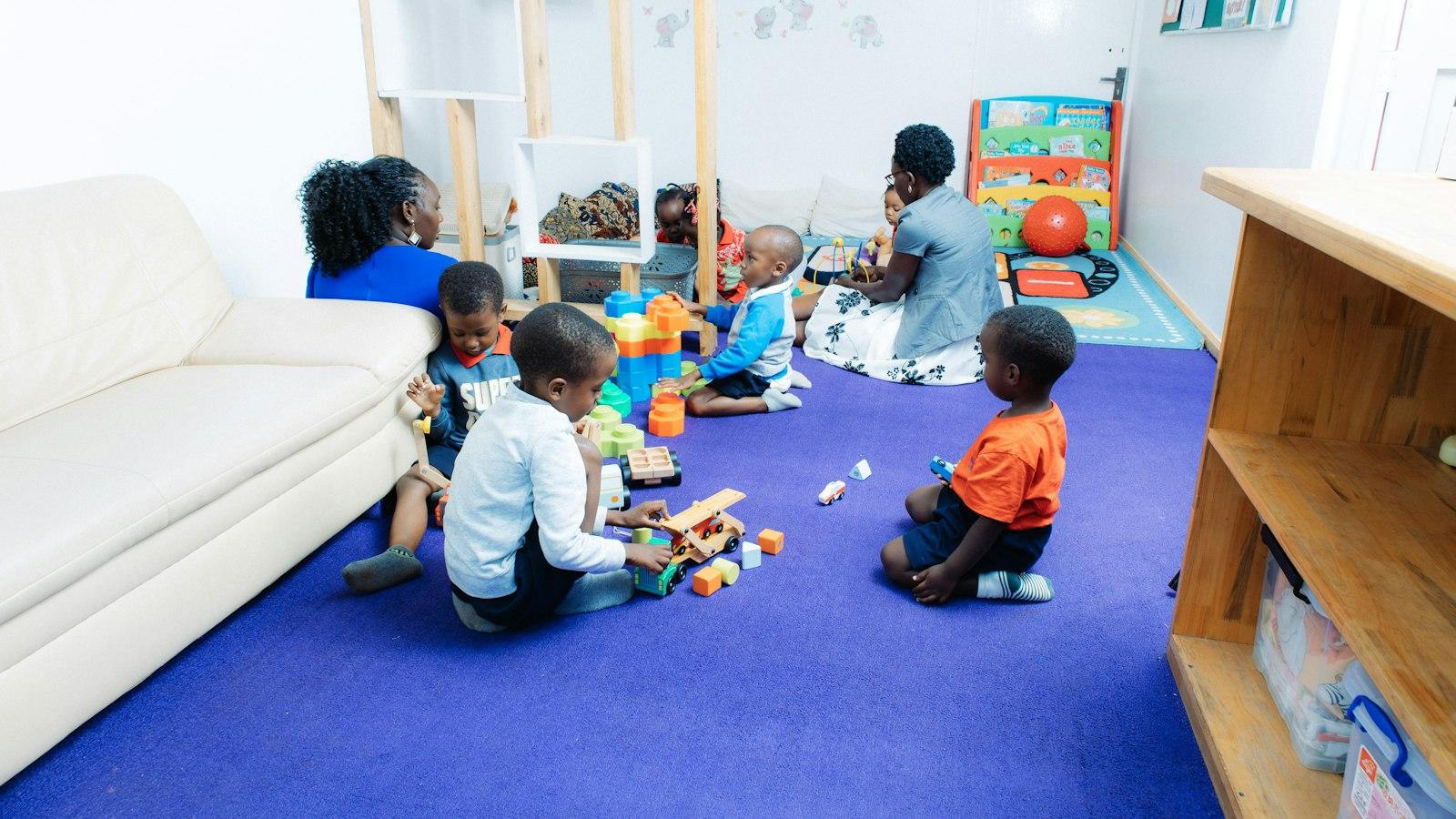
For a two-year-old, almost all emotion regulation is done by adults. Holding, naming the feeling and waiting is how a child learns to regulate. Photo: Ayrus Hill on Unsplash
Relationships first: key person and secure attachment
The toolkit's evidence strand on positive relationships asks whether key person arrangements and routines build children's feelings of security and support their character development, and whether practitioners understand the importance of secure attachments. This is not decoration. Research on teacher-child relationships has repeatedly found that the emotional quality of the relationship drives behaviour.
Hamre and Pianta (2001) showed in a longitudinal study that the quality of the teacher-child relationship in kindergarten predicted behavioural and academic outcomes through to eighth grade, with the strongest effects for children who started with behavioural difficulties. Sabol and Pianta (2012) reviewed the field and concluded that warm, low-conflict relationships support children's engagement and adjustment, and that children who are at risk benefit most. Denham and colleagues (2003) found that preschoolers' emotional competence, including their understanding and expression of emotions, was associated with their social competence with peers.
For practitioners, the implication is that behaviour support starts before the incident. A child who has a trusted key person is more likely to take comfort from that adult, accept redirection and return to play. A setting where key person arrangements are weakly operated, perhaps because of rotas and shift patterns, will find behaviour harder to manage, and inspectors will see it: children who do not turn to an adult when upset, children who are handled differently by whoever is nearest, adults who do not know what a particular child needs.
Slot, Leseman, Verhagen and Mulder (2015) found in Dutch settings that process quality, the moment-to-moment quality of interaction, was what most closely reflected children's experience, and that it was only loosely tied to structural features such as ratios and qualifications. Behaviour and attitudes are a product of process quality. They cannot be produced by a policy.
Routines: why predictability is a teaching tool
The title of the area contains the word "establishing", and the toolkit expects children to be taught to follow routines, manage their feelings and understand the impact of their behaviour on others. It also expects leaders and practitioners to help families build routines.
The research on routines comes largely from family studies but translates readily. Spagnola and Fiese (2007) reviewed evidence that regular routines and rituals in family life are associated with better child health, language, social competence and academic outcomes, and that their value comes from predictability and from the sense of belonging and identity they build. A nursery day with a recognisable shape, such as arrival, play, snack, outdoors, lunch, rest and home, allows children to anticipate what is coming and therefore to regulate their own responses. A routine that is constantly changed or rushed removes that anticipation and increases distress.
A routine is not the same as a timetable, though. Routines that are rigid and adult-led, in which children are herded through changeovers regardless of their engagement, can be a source of conflict. A well-designed routine has a stable structure and flexible delivery: the same sequence, with warnings before changes ("two more minutes, then tidy-up song"), visual cues, children given jobs, and adults who protect a child's deep play where possible. Inspectors will note whether children understand what is happening and whether the adults' actions help them to cooperate.
A well-designed routine has a stable structure and flexible delivery, so children can anticipate what comes next. Photo: Rewired Digital on Unsplash
Fiese and colleagues (2002), in a review of fifty years of research on routines and rituals, drew an important distinction between routine as a repeated behaviour and ritual as an activity with symbolic meaning. In a nursery, a goodbye song or a "welcome" greeting is a ritual that carries meaning beyond logistics. These small rituals make a setting feel like a community, and they feature in the toolkit's expectation of a "positive, inclusive and respectful culture".
Consistency, fairness and the question of bias
The toolkit requires expectations that all practitioners apply "consistently, fairly and effectively". The Needs Attention descriptor includes a setting where expectations are appropriate but inconsistent practice harms some children. This is a demanding standard for a team, because consistency means a shared understanding of what "good" looks like and how to respond when it does not occur.
Fairness has a research dimension that managers should take seriously. Okonofua and Eberhardt (2015) found in experimental studies that teachers were more likely to see a pattern of misbehaviour and to recommend harsher discipline when the same behaviour was attributed to a Black student than to a White student. Although this work was carried out with school teachers in the United States, the mechanism, in which a behaviour is read as part of a stable pattern and a child is labelled, is general. In a nursery it can attach to many characteristics: a child's ethnicity, gender, disability, language, family circumstances or simply a reputation passed between staff. The toolkit's expectation that individual needs and circumstances are considered, including those of disadvantaged children, children with SEND and children known to children's social care, reads in this light as an anti-bias requirement as well as an inclusion one.
Practically, consistency is achieved by agreeing language and responses as a team, observing each other, discussing real incidents without blame, and checking patterns in the records. If one child's name appears on every behaviour log and the others never, the question to ask is not only "what is wrong with this child?" but "what is happening around this child, and are we responding fairly?"
Explicit praise, rewards and motivation
At Expected Standard, the toolkit states that practitioners give explicit praise for positive behaviour, and the key factors include building children's motivation and positive attitudes to learning. Both phrases deserve careful reading, because praise is more subtle than it looks.
Mueller and Dweck (1998) found that praising children for intelligence, as opposed to effort, made them more concerned with performance, less persistent after failure and more likely to misreport scores. The principle for practitioners is to make praise specific and about what the child did: "you waited while Ali finished his turn, and that was kind", not "good boy" or "you're so clever". Explicit praise in the toolkit's sense names the behaviour so children learn what is valued.
The use of tangible rewards, such as sticker charts and treats, is a different matter. Deci, Koestner and Ryan (1999), in a meta-analysis of 128 experiments, found that tangible rewards that are expected and contingent on doing a task significantly undermined intrinsic motivation. A nursery that wants children to develop "positive attitudes to learning" has reason to be cautious about systems that make good behaviour a transaction. Verbal recognition, genuine interest and belonging do more for motivation than a sticker.
What helps when children struggle
For children who struggle to regulate, the toolkit asks that leaders and practitioners support them and help them to develop inhibitory control, and the Needs Attention and Urgent Improvement descriptors reflect settings where needs are not identified or responded to. A positive approach rests on a small number of evidence-based practices.
Understand the behaviour. Potegal and Davidson (2003) studied the temper tantrums of toddlers and found that they follow an identifiable pattern, with anger and distress components, and that the most effective adult response is to wait and offer comfort when the child is ready, not to escalate. A toddler's tantrum is a developmental event as much as a behavioural one.
Coach emotions. Gottman, Katz and Hooven (1996) found that parents who engage with their children's emotions, labelling and empathising before problem-solving, had children with better emotion regulation and peer relationships. Gus, Rose and Gilbert (2015) described how this approach, called emotion coaching, was adapted for use in schools and early years settings, emphasising empathy first, then limits and problem-solving. The sequence is easy to remember: connect, name, set the limit, solve together.
Use a tiered framework. Hemmeter, Snyder, Fox and Algina (2016) evaluated the implementation of the Pyramid Model for promoting social-emotional competence in early childhood classrooms, a framework that moves from universal supports (relationships and environments) through targeted social-emotional teaching to individualised intervention. They found that when practitioners implemented the model with fidelity, classroom practices improved, which is consistent with the idea that most challenging behaviour is best prevented by whole-room changes, not by individual sanctions.
The common thread is that behaviour is treated as communication and as a skill still being learned. This sits comfortably alongside the toolkit's requirement that poor behaviour is "quickly addressed": quick does not mean harsh. It means that an adult responds promptly, calmly and in a way that is consistent with the setting's approach.
Attendance and routines at home
The toolkit gives attendance real prominence. Inspectors consider whether leaders and practitioners promote punctuality and attendance, help families build routines, work with families and professionals to remove barriers, record, monitor and evaluate attendance using a range of information, and follow the attendance policy when children are absent. Strong Standard looks for decisive, evidence-led action to tackle barriers so that children establish positive routines and improve attendance before they start school. Urgent Improvement includes leaders who lack a strategic approach to poor attendance.
This might seem odd in a sector where attendance is not compulsory, but the logic is consistent with the research. Ansari and Purtell (2018) found that absenteeism in Head Start was associated with poorer learning outcomes, with the strongest negative effects for children who were absent more often. Spagnola and Fiese (2007) showed that routines at home support children's development, so the nursery's job includes helping families to build the arrival, departure and sleep patterns that make attendance and readiness possible.
In practice, this means treating a pattern of lateness or absence as information, not as a nuisance. A conversation that begins "I've noticed Tuesday mornings are hard, what would help?" is more effective than a reminder of the policy. It also means that the nursery's records should allow it to see patterns, which is why this area connects closely to the attendance monitoring that leaders are expected to carry out.
Helping families build arrival, departure and sleep patterns is part of the nursery's job. A pattern of lateness is information, not a nuisance. Photo: Kelli McClintock on Unsplash
Inclusion within the area
The toolkit asks that high expectations apply to all children, adjusted for age and stage, that reasonable adjustments are made without lowering expectations, and that approaches are monitored and adapted as needs change. For children with SEND it expects support that helps them to express feelings appropriately and handle setbacks with resilience.
Two risks follow. The first is to lower expectations for a child with additional needs in the name of kindness, so that the child is never asked to wait, share or tidy. The second is to apply the same expectation without adjusting for a child's communication, sensory or developmental profile, and to treat the resulting distress as defiance. Both fail the area, one on expectations and the other on the adjustments. The balanced position is to keep the goal high and change the route: a visual schedule, a quieter space to recover, a shorter wait, more adult support.
What this means in practice for practitioners
First, know your setting's approach in your own words. Be able to explain how the nursery teaches children to manage feelings, what you do when a child is upset, and why. Inspectors will ask, and an answer that says "we follow the behaviour policy" is weaker than one that describes what you actually do.
Second, build relationships before you need them. Spend time with your key children, learn what soothes each one, and make sure a child knows who to go to. Where your rota cuts across key person arrangements, flag it.
Third, teach emotions explicitly. Name feelings in the moment, read books about emotions, use puppets or small-world play, and model how you handle your own: "I feel a bit frustrated that it's raining, so I'm going to take a breath."
Fourth, make routines predictable and gentle. Give warnings before changes, use visual cues, involve children in tidying and setting up, and protect rest and meals from rushing. Keep the sequence steady even when the content varies.
Fifth, praise specifically. Say what the child did and why it mattered to someone else. Avoid labels and avoid turning good behaviour into a currency.
Sixth, respond to difficulty with curiosity. Ask what the child might be trying to tell you, whether it is hunger, tiredness, noise, a change at home or a missing adult. Stay calm, stay close, and wait for the child to be ready before problem-solving.
Seventh, check your own consistency. Talk with colleagues about how you each respond to the same situation. Notice who gets the corrections, whose behaviour is described as "naughty", and whether you would respond the same way if the child were different.
Eighth, work with families. Share what you notice and what works, ask what works at home, and be matter-of-fact about attendance and timekeeping. Where there are barriers, tell your manager so the setting can help.
Finally, record patterns, not just incidents. A behaviour log that shows when, where, with whom and what happened before allows the team to change the environment. A log that only lists misdeeds allows the team to build a reputation.
Conclusion
Behaviour, Attitudes and Establishing Routines is, at heart, an assessment of whether a nursery is teaching children to be part of a community: to manage themselves, to care about others, to know what to expect and to attend regularly enough to benefit. The research is clear that these capacities are learned, that they begin with secure relationships and predictable days, and that they matter for later life. The toolkit's descriptors turn that research into inspection questions. Practitioners who understand why they are asked will find that the answers are mostly good early years practice done deliberately, consistently and fairly.
References
Ansari, A. and Purtell, K.M. (2018) 'Absenteeism in Head Start and children's academic learning', Child Development, 89(4), pp. 1088-1098.
Bierman, K.L., Nix, R.L., Greenberg, M.T., Blair, C. and Domitrovich, C.E. (2008) 'Executive functions and school readiness intervention: impact, moderation, and mediation in the Head Start REDI program', Development and Psychopathology, 20(3), pp. 821-843.
Blair, C. and Raver, C.C. (2015) 'School readiness and self-regulation: a developmental psychobiological approach', Annual Review of Psychology, 66, pp. 711-731.
Deci, E.L., Koestner, R. and Ryan, R.M. (1999) 'A meta-analytic review of experiments examining the effects of extrinsic rewards on intrinsic motivation', Psychological Bulletin, 125(6), pp. 627-668.
Denham, S.A., Blair, K.A., DeMulder, E., Levitas, J., Sawyer, K., Auerbach-Major, S. and Queenan, P. (2003) 'Preschool emotional competence: pathway to social competence?', Child Development, 74(1), pp. 238-256.
Diamond, A. (2013) 'Executive functions', Annual Review of Psychology, 64, pp. 135-168.
Diamond, A. and Lee, K. (2011) 'Interventions shown to aid executive function development in children 4 to 12 years old', Science, 333(6045), pp. 959-964.
Eisenberg, N., Spinrad, T.L. and Eggum, N.D. (2010) 'Emotion-related self-regulation and its relation to children's maladjustment', Annual Review of Clinical Psychology, 6, pp. 495-525.
Fiese, B.H., Tomcho, T.J., Douglas, M., Josephs, K., Poltrock, S. and Baker, T. (2002) 'A review of 50 years of research on naturally occurring family routines and rituals: cause for celebration?', Journal of Family Psychology, 16(4), pp. 381-390.
Gottman, J.M., Katz, L.F. and Hooven, C. (1996) 'Parental meta-emotion philosophy and the emotional life of families: theoretical models and preliminary data', Journal of Family Psychology, 10(3), pp. 243-268.
Gross, J.J. (1998) 'The emerging field of emotion regulation: an integrative review', Review of General Psychology, 2(3), pp. 271-299.
Gus, L., Rose, J. and Gilbert, L. (2015) 'Emotion coaching: a universal strategy for supporting and promoting sustainable emotional and behavioural well-being', Educational and Child Psychology, 32(1), pp. 31-41.
Hamre, B.K. and Pianta, R.C. (2001) 'Early teacher-child relationships and the trajectory of children's school outcomes through eighth grade', Child Development, 72(2), pp. 625-638.
Hemmeter, M.L., Snyder, P.A., Fox, L. and Algina, J. (2016) 'Evaluating the implementation of the Pyramid Model for promoting social-emotional competence in early childhood classrooms', Topics in Early Childhood Special Education, 36(3), pp. 133-146.
Kochanska, G., Coy, K.C. and Murray, K.T. (2001) 'The development of self-regulation in the first four years of life', Child Development, 72(4), pp. 1091-1111.
Moffitt, T.E., Arseneault, L., Belsky, D., Dickson, N., Hancox, R.J., Harrington, H., Houts, R., Poulton, R., Roberts, B.W., Ross, S., Sears, M.R., Thomson, W.M. and Caspi, A. (2011) 'A gradient of childhood self-control predicts health, wealth, and public safety', Proceedings of the National Academy of Sciences, 108(7), pp. 2693-2698.
Mueller, C.M. and Dweck, C.S. (1998) 'Praise for intelligence can undermine children's motivation and performance', Journal of Personality and Social Psychology, 75(1), pp. 33-52.
Okonofua, J.A. and Eberhardt, J.L. (2015) 'Two strikes: race and the disciplining of young students', Psychological Science, 26(5), pp. 617-624.
Potegal, M. and Davidson, R.J. (2003) 'Temper tantrums in young children: 1. Behavioral composition', Journal of Developmental and Behavioral Pediatrics, 24(3), pp. 140-147.
Sabol, T.J. and Pianta, R.C. (2012) 'Recent trends in research on teacher-child relationships', Attachment and Human Development, 14(3), pp. 213-231.
Slot, P.L., Leseman, P.P.M., Verhagen, J. and Mulder, H. (2015) 'Associations between structural quality and process quality in Dutch early childhood education and care settings', Early Childhood Research Quarterly, 33, pp. 64-76.
Spagnola, M. and Fiese, B.H. (2007) 'Family routines and rituals: a context for development in the lives of young children', Infants and Young Children, 20(4), pp. 284-299.
Operations Director, Awake Early Years Consultancy
Former Ofsted Early Years Inspector, doctoral researcher and early childhood education and care consultant with over 16 years' experience across practice, inspection and leadership.